Aging in Place Is More Than a Single-Story Home
TLDR: Aging in place isn't a single-story floor plan and a row of grab bars. It's living well in your own home for as long as you can, which means designing for the life you want, not just guarding against decline. The real work is the site and the entry, the cheap decisions you can only make before the walls close, and choosing the right features instead of all of them. Done well, none of it looks like a hospital. It just looks like a house that still works when you're ninety.
Aging in place is a weird label because it reads as if the alternative, getting sent to a nursing home, is the norm.
Let's define aging in place. I define it as living gracefully and independently, in your home for as long as possible into your old age. How do you do it? There's a whole bag of tricks, techniques, considerations, big and small.
In Gig Harbor, having a primary on main (aka “master on main”) single story living is very popular. The fact that it’s such a selling point shows the demand for aging in place, whether people call it that or not.
But unless you have a holistically designed aging in place home that smartly considers every aspect of design, every aspect of what you might need down the road. It could be a half solution.
Make space for what you love.
Aging in place gets talked about like damage control. Don't fall, don't get hurt. That skips the better half of it. When you retire, you’re about to have time you haven't had since you were a kid, and the house should make room for all the things you love to do.
I once designed an accessory building in Fox Island for a couple of retiring engineers, and the whole thing was a temple for their hobbies. Space to tinker on cars, a place to paint, room to make a mess and leave it out. The roof was a giant rainwater collector (we met at our community garden after all). Engineers don't stop wanting to take things apart. They finally just have the time to do it for fun.
The Gig Harbor waterfront project has a shop for pottery. A real room integrated in the flow of the house, set up for the work, where the wheel and the kiln and the dust all have somewhere to live.
This is the part people leave out when they picture getting old. The square footage usually goes to bedrooms nobody sleeps in and a dining room used twice a year. Give it to the thing you'll do every day instead. Not a concession to age. The reward for it.
The entry is the real test, not the floor plan.
Single-story living solves one floor. It says nothing about traversing the landscape, getting from the car to your door, or from the door down to the water. On a waterfront lot the site is the whole reason you're there, and the one thing that won't get easier as you age. No AI checklist can solve it for you.
Think about the typical builder "custom home." What's the sequence from car to inside? Is it a second-class entrance? You spend everything on the house and let your daily arrival feel like the servant's entry, while the big front door sits there for show and never gets used. What's the point of that?
A current Gig Harbor waterfront client sent me a sketch. Garage, then four steps up to a back hallway. Which is fine. It's not their job to be the architect. They drew what everyone's seen, and my job is to read between the lines for what you actually need.
Design is more than walls. It's how you move through the house. So instead of four steps to a side door, what if your way in was a graceful, dignified sequence that kept you covered and safe without feeling like the back entrance? It's your house. Your way in should be the best way in.
What gets locked in at framing?
Some decisions are nearly free while the walls are open and brutal once they're closed. Hallway widths, blocking in the walls, a curbless shower. None of it shows, and all of it has a window that closes the day the drywall goes up.
Take a grab bar. The blocking to hold one costs almost nothing during framing. Call it a hundred dollars. Add it later and the math is completely different. If there's tile or stone on that wall, you're tearing it out, backing it, and re-cladding it, which runs into the thousands and sometimes tens of thousands. Best case, with plain drywall behind, you're still cutting it open, fitting the blocking carefully, and patching. A thousand dollars minimum to undo what fifty would have covered.
A retired couple I spoke with recently built a house across the country. They just moved in. She already regrets skipping curbless showers. It hadn't occurred to them, and it wasn't raised during design. The curb is small but even a fraction of an inch is a tripping hazard when you are thinking very long term. The cost of changing your mind about it after the tile is set is not.
An elevator is the extreme version. It's expensive to add to a finished house, and not only because of the footprint you have to carve out. The harder problem is physical. Getting the equipment into a house that's already built and finished is a job in itself. The cheap moment is before there's a house in the way.
It isn't only what's hidden in the walls. Some choices sign you up for a big, disruptive project down the road, at exactly the age you'd least want one.
Flooring is an easy example. LVP costs less than wood up front, and it wears. Can you picture emptying every room of furniture to replace the floors twenty-five years from now? Do the math on how old you'll be. A roof raises the same question. Asphalt is cheaper than metal and needs replacing. The cost of asphalt roof replacement can be shocking. The smaller number today can buy you the bigger disruption later, and disruption is the part that gets harder with age.
So the real question isn't what's cheapest to install. It's what you'll still be willing to tear out and redo at seventy-five.
Do you actually need all of it?
A client once wanted automatic faucets. I talked them out of it. They're electronic, so they can fail. More to the point, they run at one temperature. That's fine for washing your hands in an airport. It's not what you want at your own sink, where some days you want it warm and some days cold. Who wants to dig under the sink to change the water temperature?
You have to think to the end. Not just where someone's body is today, but the independence they'll want at ninety. Picturing yourself at ninety is hard. Picturing a parent or grandparent coming to stay is easier, and it asks the same question. What would the house ask of them? Where would they have a hard time?
A “Japanese style” toilet is worth it for more reasons than I can fit here. It is a luxury I wouldn’t want to live without, and it gives peace of mind that you’ll easily have more independence in one of your most delicate and personal everyday moments. If a client isn't ready for one, I still push to put an outlet behind the toilet. Then adding it later is simple, instead of opening a wall to find power.
Sitting down in the shower is a real luxury when it's done right. I'll heat the bench so it's warm to the touch. It doesn't have to look or feel like a hospital bathroom to have a place to sit. And the day sitting stops being optional, the bench is already there.
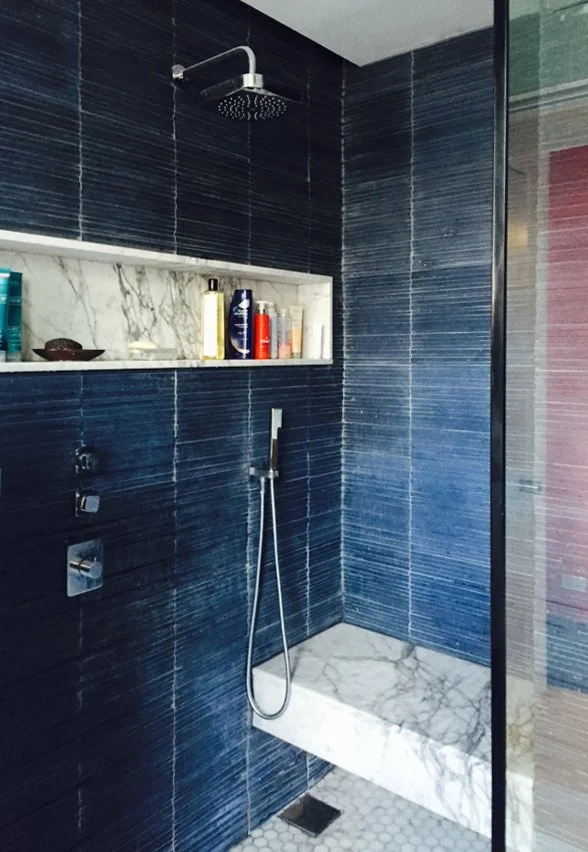
Shower bench
This bathroom features a heated stone bench and a hand shower within reach for comfortable bathing.
I wouldn't put grab bars in now if a client doesn't need them. They get better looking every year, so there's no reason to mount today's version on a wall you'll live with for twenty. Plan the drawings right and the blocking is already in. Adding them later takes an afternoon, not a renovation.
What does aging actually feel like in your home?
There’s a difference between knowing and understanding. I’ve worked for couples and families before having a family of my own. And I understood, but now I know. The difference started to dawn on me when I was chatting with some architects, and a mom in the group said she just wanted to go to the pharmacy by herself. I tilted my head in curiosity, but now when I tell that story all the parents burst into laughter. That’s knowing.
So how does an architect ‘know’ how it feels to have arthritis, or diminished sight and hearing, or decreased muscle strength without aging prematurely? I put on a futuristic “AgeExplorer” suit. It stiffens your joints, weakens your grip, and clouds your vision and dulls your hearing.
Turning a knob was painful. Everything felt heavier. I took the suit off with one firm opinion. I will never put a knob on a kitchen or door again.
A lever you can work with a wrist, an elbow, or a full hand of groceries. A knob needs grip and a twist, which is the first thing arthritis takes. The gripping hurt more than expected.
The yellowed vision was no match for my superhuman color deciphering. The yellowed vision didn't fool my eye for color. It fooled everything else. Edges I'd normally catch went flat. A white counter on a white floor, a step the same tone as the landing, gone. That's where people fall, so you design more light than you'd think, less glare, and a little contrast where an edge needs to be read. But it was harder to hear. That alone gives radiant heat another subtle benefit. It is silent, where air moving HVAC has blowers that make sound. As slight as it may seem to someone with great hearing, it could be enough to disturb and frustrate someone who cannot hear clearly.
Aging in place was never about the nursing home you're avoiding. It's about the pottery, the half-built engine, the space that's finally yours. What do you want to leave room for in your home after retirement?