What hidden costs should I be aware of when hiring an architect for a major remodel?
TL:DR: The hidden costs of hiring an architect for a major remodel usually aren't hidden on purpose. They show up when hours run past the estimate, when a percentage-based fee ties your architect's pay to decisions that have nothing to do with design, when a flat-fee contract quietly switches to hourly billing after your revisions run out, and when finished designs come back from contractors 50% over budget.
None of these are dealbreakers. They're just the four places homeowners get surprised, and every one of them is avoidable if you ask about it before you sign.
Why do architect hours balloon way past the original estimate?
Imagine hiring an architect who quotes a job as taking about 80 hours, then it takes 400+. Let me start by saying I’ve utilized every which way of billing (hourly, percentage, flat fee, hybrids). I can tell you from an architect’s perspective, that clients can underestimate what they want, the scope can change, their desires can change during design (almost always upwards).
Was it just a case of the client wanting more and more revisions? That happens plenty. Can an architect underquote a job? Of course. Why? Sometimes it's all of the above, and sometimes it's the architect underestimating what’s involved, especially if they are inexperienced. It will inevitably happen if the scope of the project is not well defined and if the architect doesn’t inform the client in real time that added scope will increase their hours.
It sounds so obvious that it doesn’t need saying, but it does. Clients rarely look or think back to their contract once design begins.
2. Should your architect make more because you bought a $20,000 refrigerator?
Homeowners get wildly different quotes for what they think is the same scope of work, with no clear explanation of what is driving the difference. Should your architect make more money because you chose the $20,000 fridge that keeps your grapes cold or the $10,000 skylight that closes when rainwater touches it?
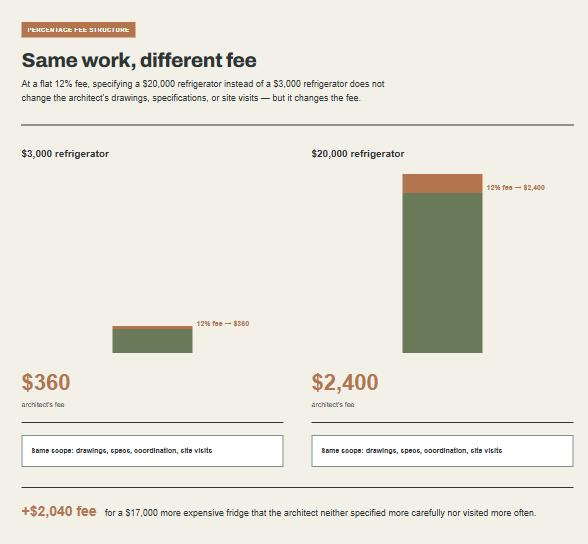
The argument for it is that these more expensive versions of home elements can take more time and coordination to design and detail. Sometimes yes. Is it the driving factor? I don’t think so.
I don’t like construction cost as the deciding factor for many reasons. One, I’d like the value of the design to stand alone. Maybe the most brilliant design can also be economically built. Should the architect be penalized for that? Or rewarded? Also, given that every general contractor, even comparable ones of the same quality and stature, can vary greatly in price, I don’t like the idea of my compensation being tied to someone else’s business decisions.
3. The moment your flat-fee architect quietly starts billing you by the hour
Here’s one that I often have in my own flat fee contracts. A set number of design revisions per phase, with hourly billing for additional revisions. It is one of those clauses that just has to be in there with a flat rate project to protect the architect against clients who see design as an all you can eat buffet for the indecisive. That being said, to start the clock without reminding the client feels like bad manners. As I already mentioned, clients seem to forget the contract terms once they sign, and need reminding of what they agreed to when things get sticky. To just drop a surprise bill because it was in the agreement without some sort of announcement or reminder might be well within the architect’s rights, but cause tension all the same. The better way to do this is to bring it up beforehand. Who knows, the “threat” of additional billing might awaken the decisive action you needed.
4. Construction bids way over budget
If the design phase goes off smoothly, and you get some amazing design with every little detail covered, only to find that bids are 50% over your budget, how would you feel? That’s happened a lot. There are the rare architects who can estimate the cost of their designs to within 1-2 percent of actual bids. But they are not the norm. Perhaps they’re doing similar work with the same construction companies over and over. What makes this much more common is that, especially in residential construction, bids vary wildly. I used to do design-bid-build, meaning that I’d design everything down to the doorstops, then get general contractors involved (sometimes just after permit applications are approved), give them a walkthrough and a couple weeks to get numbers together. I was always careful to only select similar contractors, so this wasn’t a man in a van vs high end GC with a robust support system. The results always befuddled me. The spread between the low and high bidder were always proportionally significant, and often all of them above the client’s expectations.
There is no typical cost for a project, maybe all their prices are within reasonable ranges when you look at them individually, but they add up to markedly different totals.
The fact is that residential construction isn’t like institutional builds. This is good news. Municipalities are required to get competitive bids for construction of a new high school or courthouse. You do not. You are free to choose the builder you want to work with the most. And builders of homes don’t operate the same way as commercial builders.
Do you really want to go through value engineering to chop the cost down 50% once you are ready to break ground? It leaves you in a bad spot that can lead to bad decisions, like hiring the GC who claims they can do it for $x, only to end up with change order after change order that raises it to what all the others cost anyway. Ask me how I know.
I’ve been burned before, and that’s why I built a better system. Explore it for yourself here.